


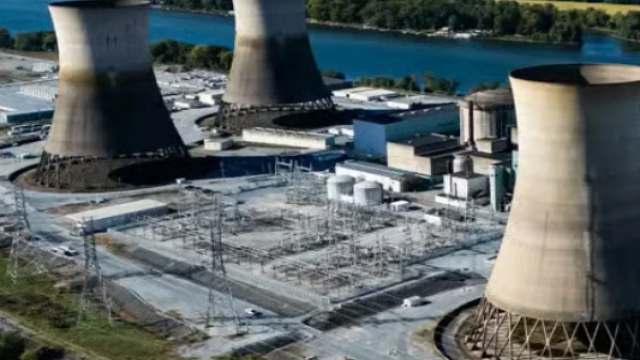
WASHINGTON, Feb 18, (V7N) - The United States is prepared to resume low-yield nuclear tests to match alleged secret explosions by China and Russia, ending a decades-long moratorium on such testing, according to a senior US official on Tuesday.
Christopher Yeaw, the Assistant Secretary of State for Arms Control and Nonproliferation, confirmed that President Donald Trump was serious about his October statement regarding the resumption of nuclear tests. Yeaw explained that the United States would only carry out tests on an “equal basis” with China and Russia, not returning to large-scale atmospheric testing like the "Ivy Mike" 1952 thermonuclear explosion.
“Equal basis doesn’t mean we’re going back to multi-megaton atmospheric testing,” Yeaw said at the Hudson Institute, referring to the massive tests of the early Cold War era. He stressed that the resumption of nuclear testing would be a "level playing field" in response to actions by China and Russia.
While the United States has not yet set a date for when testing will begin, Yeaw emphasized that the decision would be made by Trump. The expiration of the New START treaty with Russia earlier this month has escalated concerns over global nuclear arms control, with Trump calling for a new agreement that also includes China, which has refused to join such talks.
The US government has accused China of conducting a low-yield nuclear test in 2020 and preparing for further nuclear explosions. Yeaw reaffirmed these allegations, citing data from Kazakhstan that detected a 2.75-magnitude explosion, likely underground. The United States has claimed that this was an explosion consistent with nuclear testing.
However, China has vehemently denied these allegations, labeling them as "outright lies" designed to justify the US resumption of nuclear testing. The Comprehensive Nuclear-Test-Ban Treaty Organization (CTBTO) has also stated that it did not detect any nuclear tests matching the US accusations.
Despite this, Yeaw criticized the CTBTO’s monitoring capacity, suggesting that its failure to detect low-yield tests undermines its effectiveness. He also took aim at Robert Floyd, the head of the CTBTO, calling for a reevaluation of the organization’s priorities.
The US’s stance highlights the ongoing tensions in nuclear arms control, especially as the New START treaty, the last agreement between the US and Russia to limit nuclear warheads, has expired. As the United States, China, and Russia are all modernizing their nuclear arsenals, the global arms control regime faces uncertainty.
The CTBT, which would ban all nuclear explosions, has not yet come into force, as key nuclear powers, including the US, have not ratified it. The treaty, which was signed in 1996, remains a contentious issue in US politics, with Republican opposition preventing its ratification in the Senate.
The United States conducted its last nuclear test in 1992 but has since focused on subcritical tests—experiments that don’t reach the threshold of a full nuclear detonation but ensure the reliability of its nuclear arsenal. These tests have been a key part of US nuclear policy since the 1990s.
As tensions escalate over the nuclear ambitions of China and Russia, the global landscape of nuclear weapons and arms control remains uncertain, with the potential resumption of US testing marking a new chapter in the arms race.
END/WD/RH















Comment: