


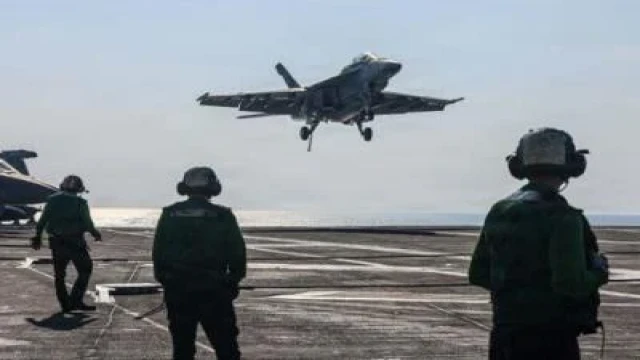
WASHINGTON, United States, Feb 19, (V7N) — A massive US military buildup in the Middle East, including an extensive array of warships, fighter jets, and refueling aircraft, is setting the stage for a potential sustained military campaign against Iran, depending on President Donald Trump's decision. This increase in military presence, which includes two aircraft carriers and a variety of fighter jets, marks an escalation in the ongoing tensions between the two nations.
Trump has long threatened further military action against Iran, especially if diplomatic talks aimed at replacing the nuclear deal that the US president abandoned in 2018 fail to produce results. Reports from CNN and CBS have indicated that US military forces could be prepared to launch strikes against Iran as soon as this weekend, though Trump has yet to make a final decision.
As of now, the US has stationed 13 warships in the region, including the aircraft carrier USS Abraham Lincoln, nine destroyers, and three littoral combat ships, with more expected to arrive soon. Additionally, the USS Gerald R. Ford, the largest aircraft carrier in the world, is currently en route to the Middle East from the Atlantic, accompanied by three destroyers. It is rare for the US to deploy two aircraft carriers to the region at the same time, underscoring the heightened military readiness.
The buildup also includes a large fleet of aircraft, notably F-22 Raptor stealth fighters, F-15 and F-16 warplanes, and KC-135 aerial refueling planes to sustain operations over extended periods. Flight-tracking data has shown multiple KC-135s operating near or within the Middle East, alongside other support aircraft such as E3 Sentry airborne warning and control planes.
This concentration of military firepower in the region has created what experts describe as a "momentum" of its own, making it increasingly difficult to halt any military action once initiated. Susan Ziadeh, a senior advisor at the Center for Strategic and International Studies, noted that "sometimes that momentum is a little hard to just put the brakes on and say, that's it, we're not doing anything."
The US presence in the region is a direct response to the recent unrest in Iran, where protests, initially sparked by economic grievances, evolved into mass demonstrations against the clerical leadership. In response, the Iranian government has used violent force to quell the protests, and Trump has warned that any further crackdown would lead to military intervention.
While US military options remain on the table, diplomatic efforts have also been underway. US and Iranian officials met in Geneva this week for talks aimed at preventing military intervention. Iran reported that the two sides had agreed on "guiding principles" for a potential deal, though White House Press Secretary Karoline Leavitt indicated that significant gaps remain between the two sides. Leavitt added that while some progress had been made, the US and Iran are still "very far apart on some issues."
The Biden administration has long advocated for a diplomatic resolution, but President Trump has repeatedly suggested that military action might be necessary. Leavitt pointed out that there are "many reasons and arguments that one could make for a strike against Iran," signaling that the US is still weighing its options in dealing with Tehran.
The situation remains precarious, with both diplomatic and military avenues still open. Trump's military buildup sends a clear message to Iran, but the final decision rests with the president, who has already demonstrated a willingness to back down from military action in the past under certain conditions. However, as tensions continue to escalate, the potential for military intervention remains high, with the region on edge as both sides continue to negotiate their next moves.
END/WD/RH/














Comment: