


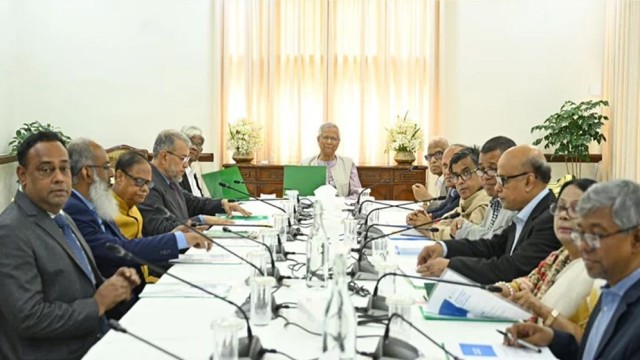
Dhaka, Dec 22 (V7N)- A high-level meeting was held under the leadership of Chief Adviser Professor Dr. Muhammad Yunus to review the country’s overall economic progress and budget expenditure. The meeting took place at State Guest House Jamuna on Monday.
Financial Advisor Salehuddin Ahmed, Planning Advisor Wahiduddin Mahmud, and Bangladesh Bank Governor Ahsan H Mansur attended the meeting.
The meeting reviewed key economic indicators, including inflation, wage growth, agricultural production, foreign exchange reserves, current account, expatriate income, imports, and progress in opening industrial sector credit lines.
It was reported that the country’s 12-month average inflation fell below 9 percent in November 2025, reaching 8.29 percent on a point-to-point basis, continuing a steady decline since June 2025. With the government’s contractionary monetary policies and austerity measures, inflation is expected to fall below 7 percent by June 2026.
Regarding wage growth, the meeting noted that the gap with inflation has narrowed, with November figures at 8.04 percent, close to the inflation rate, which is expected to gradually restore real income.
On agriculture, the meeting highlighted good yields of Boro and Aman paddy, with Aman paddy production reaching 160.95 million metric tons as of December 15. Although Aush paddy production fell slightly, overall output increased by 7.20 percent compared to the previous fiscal year.
In the financial sector, the gross foreign exchange reserves reached $32.57 billion as of December 18, up from $25 billion in August 2024, with further increases expected due to stabilized exchange rates, higher expatriate income, and rising interest rates. The current account deficit has also improved, falling to $139 million at the end of the 2024-25 fiscal year.
Expatriate income showed strong growth, with 500,000 workers confirmed for overseas employment during July-November, generating $13.04 billion, a 17.14 percent increase over the previous year.
The meeting also highlighted the lifting of some import restrictions, leading to 6.1 percent growth in imports during July-November 2025, and progress in opening letters of credit for industrial equipment and raw materials, signaling renewed confidence in the economy.
Participants concluded that economic stability is gradually returning due to strengthened discipline and management in the financial sector.
END/SMA/AJ




















Comment: