


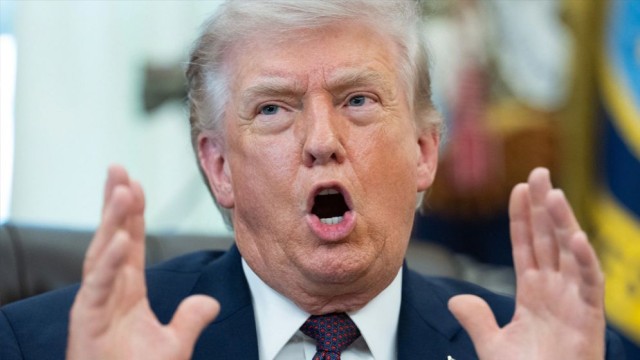
WASHINGTON, Apr 01 (V7N) — In a move that has sent shockwaves through the global security establishment, U.S. President Donald Trump announced on Wednesday that he is "seriously considering" withdrawing the United States from NATO. In an exclusive interview with the British daily The Telegraph, Trump labeled the 77-year-old alliance a "paper tiger," claiming it has failed to support the U.S. during the critical 32nd day of its conflict with Iran.
The President’s frustration stems from the refusal of European allies to deploy warships to the Strait of Hormuz, which remains virtually closed due to Iranian naval actions. With 20 percent of the world's oil passing through this artery, the closure has pushed global crude prices past $115 per barrel, fueling fears of a global recession.
"They Were Not There for Us"
President Trump criticized the lack of reciprocity within the alliance, contrasting current events with U.S. support for Europe in past crises.
-
The Loyalty Gap: "We have always stood by our allies, even on the Ukraine issue. But they were not there for us when it mattered most," Trump told The Telegraph.
-
Perception of Weakness: He claimed that Russian President Vladimir Putin is "acutely aware" of NATO's internal fractures and lack of naval readiness.
-
UK Under Fire: Trump specifically targeted the United Kingdom, describing the Royal Navy as "weakened" and unable to project power. He further criticized Prime Minister Keir Starmer for prioritizing renewable energy over defense spending.
The "Pay-to-Play" Model and Troop Withdrawals
U.S. Secretary of State Marco Rubio echoed the President’s sentiments, describing NATO as a "one-sided relationship." Sources within the administration suggest drastic structural changes are being drafted:
-
The Participation Tax: A proposed "pay-to-play" model would limit the decision-making power of member states that fail to meet the 2% GDP defense spending target.
-
German Deployment: Washington is reportedly reconsidering the presence of U.S. troops in Germany, citing a lack of strategic alignment during the current Middle East crisis.
-
Base Access Denied: Secretary Rubio expressed particular dissatisfaction with allies who have blocked the U.S. from using European military bases for operations related to the Iran conflict.
Keir Starmer’s Rebuttal
In a swift response from 10 Downing Street, Prime Minister Keir Starmer defended the alliance while drawing a firm line on British involvement.
-
Not Britain's War: Starmer stated that the Iran conflict "is not Britain's war" and confirmed the UK has no plans to join the U.S.-Israeli offensive.
-
European Pivot: While reaffirming that NATO remains the "most effective military alliance in the world," Starmer signaled that the UK may seek closer defense ties with European partners independent of Washington's current trajectory.
The Article 5 Dilemma
The legal friction lies in the interpretation of NATO’s collective defense clause. While Article 5 mandates that an attack on one is an attack on all, it was not triggered in this instance. Because the current conflict was initiated by a joint US-Israeli strike rather than an unprovoked attack on a member state, European allies argue they are under no legal obligation to provide military support.
As the war enters its second month, the potential exit of the United States—NATO’s primary financier and military backbone—threatens to dismantle the post-WWII security architecture of the Western world.
END/SMA/AJ










Comment: