


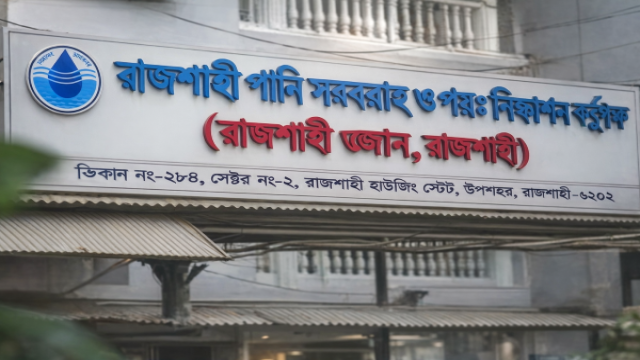
Rajshahi, Feb 04 (V7N) - Despite multiple water tariff hikes and a steady rise in customer numbers, the Rajshahi Water Supply and Sewerage Authority (WASA) continues to incur significant financial losses, raising concerns about management efficiency and financial transparency.
In 2022, Rajshahi WASA increased water prices three times in a single year. Later, it sent a proposal to the Ministry of Local Government, Rural Development and Cooperatives seeking approval for a further 30 percent tariff hike by the end of 2024. However, the proposal has yet to receive approval.
Audit reports from the last three fiscal years show that although revenue from water sales and tenders increased substantially, expenditure grew at an even faster pace, resulting in widening deficits.
According to audit data, WASA’s revenue rose from Tk 5.13 crore in the 2022–23 fiscal year to Tk 17.26 crore in 2023–24, before declining to Tk 13.62 crore in 2024–25. Meanwhile, the number of registered customers increased every year—from 48,645 in 2022–23 to 49,958 in 2023–24, and 51,642 in 2024–25.
However, discrepancies between audit reports and annual financial statements have further complicated the picture. The audit report for 2022–23 shows revenue collection of Tk 17.26 crore—more than three times the Tk 5.13 crore stated in the annual report for the same year. Total income stood at Tk 20.31 crore, while expenditure reached Tk 30 crore, creating a substantial deficit.
In 2023–24, revenue collection rose to Tk 19.58 crore, with total income of Tk 23.23 crore against expenditure of Tk 31.94 crore. The situation worsened in 2024–25, when revenue increased to Tk 20.18 crore and total income to Tk 25.62 crore, but expenditure surged to Tk 37.30 crore—the highest in the three-year period.
Financial analysts say the growing gap between income and expenditure, despite rising customer numbers, points to structural inefficiencies.
“When both customers and revenue are increasing, continued losses suggest uncontrolled operating costs, weak procurement practices, or systemic financial leakage,” said a former WASA official, speaking on condition of anonymity.
Responding to the concerns, Rajshahi WASA Chief Revenue Officer Mehedi Hasan said customers pay water bills quarterly, and delayed payments are often recorded in the following fiscal year rather than the year in which services were provided.
Explaining the discrepancy between audit and annual reports, Chief Budget Officer Abdur Rahman said the figures in the audit report reflected revenue targets, while the annual report showed actual collections.
WASA Deputy Managing Director (Finance and Administration) Touhidur Rahman said water tariffs were last increased in 2023, although regulations require a five percent annual adjustment.
“Several major projects are currently under implementation. Once these projects are completed, we expect to improve operational efficiency and gradually reduce losses,” he said. He also acknowledged the existence of outstanding bills, adding that efforts were underway to accelerate their recovery.
Meanwhile, civil society representatives have voiced concern over the financial burden on residents. Jamat Khan, general secretary of Rajshahi Raksha Sangram Parishad, said the lack of transparency could ultimately harm consumers.
“Customers are increasing and people are paying their bills, yet the organization continues to incur losses,” he said. “Without accountability and transparency, the financial burden may eventually be shifted onto the public.”
END/RAR/RH/









Comment: